
AfterYes™
AI can do the work. AfterYes™ governs what becomes real.
AI can research, recommend, negotiate and coordinate work across many different systems. But an AI-generated instruction should not become a real-world consequence simply because it arrived.
AfterYes™ governs each consequential economic moment: the point at which a proposed action is about to become real.
The simple rule
Each organization remains independently governed. It makes its own local decision and remains responsible for it.
Proof can cross a boundary. Authority and reliance do not.
AI may propose and perform work within the authority it has been given. A consequence occurs only after an accountable local party has established who is acting, what they may do, whether that authority is still valid and whether the proposed action matches it now.
One MRI appointment. Four protected moments. Two independent boundaries.
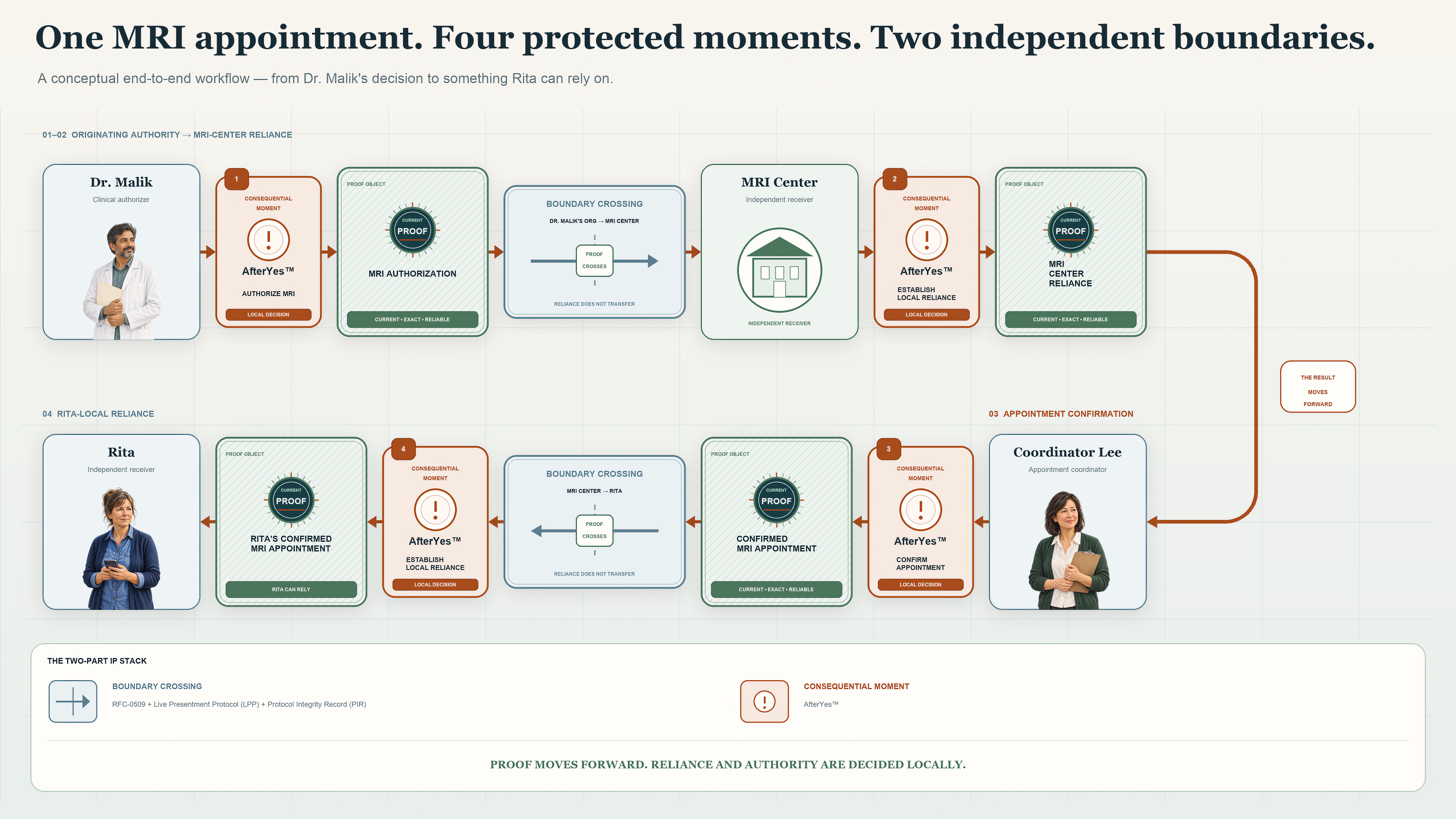
How to read the journey
- Blue marks a boundary between independently governed systems.
- Orange marks a consequential moment where an accountable local decision is required.
- Green represents proof that can be evaluated and relied upon within the receiving domain.
The diagram follows one MRI appointment from Dr. Malik's initial decision to something Rita can ultimately rely on.
- Dr. Malik decides that Rita needs an MRI. That decision produces proof of what was authorized.
- The proof crosses into the MRI Center's independently governed environment. The center does not inherit Dr. Malik's authority or automatically trust what arrived. It evaluates the proof against its own requirements and makes its own local decision.
- Coordinator Lee confirms the appointment through another protected consequential moment. The confirmation then crosses back to Rita.
- Rita remains the invariant throughout the journey. She receives proof of the confirmed appointment and decides whether she can rely on it.
Proof moves forward. Reliance and authority are decided locally.
At the boundary
What happens before a consequence can occur
When proof arrives from another system, the receiving organization must first understand what reached its boundary before it can make a protected consequential decision.
The receiving-boundary architecture is needed when proof crosses into a receiver; an originating decision does not require a preceding incoming boundary crossing. Dr. Malik can make his initial decision locally. The MRI Center must evaluate what crosses into its domain.
Presentment is not reliance. Delivery is not acceptance. Arrival does not create effect.
01
The 410 enables
The 410 enables an enterprise to organize a changing ecosystem around the person and an outcome worth producing. It brings the relevant participants, capabilities, context and terms into view. That may include a physician, imaging center, coordinator, payer or another service provider.
Assembling the ecosystem does not mean that every participant has accepted responsibility. Each remains independently governed.
02
RFC-0509 makes the boundary legible
Proof may arrive as an approval, credential, receipt, policy result, execution trace or another evidence package. RFC-0509 provides a public, neutral grammar through which a supplier can describe what its proof demonstrates and a receiver can state what it requires.
The receiver can then evaluate whether the proof fits this action, under its own rules, now, and signal its own boundary outcome. RFC-0509 does not certify the proof or decide whether the receiver must act. The receiver remains sovereign.
03
LPP governs the evaluation
A common language is necessary, but it is not sufficient. LPP governs the controlled receiver-side presentment and evaluation. Its detailed specification is not publicly released.
Its public role is to keep arrival, evaluation and reliance distinct while the receiver applies its requirements to what was presented.
04
The PIR preserves what happened
The Live Presentment Protocol concludes with a Protocol Integrity Record. The PIR preserves evidence of what occurred during the controlled boundary process and the outcome that process reached.
The PIR establishes the integrity of the process immediately before the consequential decision. It is not permission to act. It does not transfer authority, impose trust or create the consequence.
05
AfterYes™ governs what becomes real
That is where AfterYes™ begins. An accountable local party decides whether authority, scope and current conditions support the exact proposed action now. The resulting proof records that bounded decision; it does not enlarge the authority behind it.
The hard case
When conditions change while a commitment is pending
A proposed commitment may be approaching its consequential moment while evidence of cancellation, withdrawal or changed conditions arrives at the receiver's boundary.
Arrival does not settle the result. RFC-0509 makes the evidence and the receiver's requirements legible. LPP governs the evaluation. The PIR records how that boundary process concluded. That sequence does not remotely command the receiver and does not, by itself, prove that the commitment stopped.
The receiver remains sovereign. If authority, scope and current conditions cannot be established locally, the commitment must not be treated as authorized.
If the commitment already became real before the cancellation was locally established, later evidence does not erase that fact. Any reversal or compensating action is another consequential action with its own accountable local decision.
The handover is complete only when bounded evidence tells the next operator which local outcome occurred: commitment, refusal or still unresolved. The cancellation request itself is not that evidence. Until the receiver's outcome is established, the status remains unresolved.
Cancellation requested is not cancellation proven. Delivery is not effect.
At the AfterYes™ moment
Four questions determine what may become real
- WHO is acting
- Is the person, organization or system proposing the action properly identified in the relevant domain?
- WHAT are they authorized to do
- Is the proposed action inside the authority that was actually granted?
- NOW is that authority still valid
- Is the authority current at the moment the consequence would occur?
- MATCH does the proposed action match that authority
- Do the specific action, scope and present conditions fit what was authorized?
When those questions are resolved, AfterYes™ produces bounded proof of the decision made at that moment.
The proof can support downstream work or cross into another receiving domain. The authority behind it does not travel with it.
Every subsequent receiver must establish its own basis for reliance.
Agentic AI
Useful work without invented authority
The accountability problem is not simply that AI systems make mistakes. An agent can initiate work across several organizations while responsibility fragments among the model provider, agent developer, platform operator, enterprise, vendor and end user.
Everyone may have a log. No one necessarily owns the consequential decision. A record of what an AI did does not establish who authorized it, whether the authority remained valid, whether the action stayed in scope, whether the receiver accepted responsibility or who decided it should become real.
AfterYes™ does not try to make the AI agent accountable. It creates an identifiable point where accountability can land before the proposed action becomes consequential.
AI can still do the work
Once the relevant authority and evidence have been established, AI can work within its granted scope: understand Rita's request, discover possible providers, coordinate availability, assemble options, identify missing information, prepare a proposed appointment and communicate the resulting status.
But AI does not get to manufacture authority, enlarge its permitted scope or assume that one organization's reliance binds another.
The work can be automated. The consequential decision remains bounded, local and attributable.
The result
More useful work. Clear responsibility.
AI can perform more of the work without being trusted to decide what becomes real.
Organizations can remain independent without treating every incoming request as an entirely bespoke integration.
People can remain at the center while the ecosystem around them changes.
Every consequential action can have an identifiable, locally accountable decision behind it.
AI can do the work.
AfterYes™ governs what becomes real.